rss
email
twitter
facebook
Showing posts with label central banking. Show all posts

Thursday, November 4, 2010

A Central Banker's Cocktail Party: Tequila or Water?


What is Quantitative Easing? A government monetary policy occasionally used to increase the money supply by buying government securities or other securities from the market. Quantitative easing increases the money supply by flooding financial institutions with capital in an effort to promote increased lending and liquidity.

Now that's out of the way we can dissect the size, announcement, and long-term affects of the easing on the Global Financial System.

First let us say congratulations to the United States Federal Reserve, in eight months time you will maintain a $3 Trillion balance sheet. The Central Bank is now the largest Hedge Fund in the World. Kudos, no really. Let's take a few moments to put this number into perspective. In, 2009 the U.S. GDP was $14.25630 Trillion. The IMF forecasts growth in 2010 of 2.6%. A back of the envelope calculation puts 2010 output at 14.627. Thus, in June 2011 the Federal Reserve will control assets worth 20-21% of 2010 Gross Domestic Product. In 2007, The Fed's Balance sheet was worth only 6.4% of Gross Domestic Product. All we can say is Kudos.

Consequently, the NY Federal Reserve has a tall glass to fill:

The FOMC directed the Open Market Trading Desk (the Desk) at the Federal Reserve Bank of New York to purchase an additional $600 billion of longer- term Treasury securities...Taken together, the Desk anticipates conducting $850 to $900 billion of purchases of longer-term Treasury securities through the end of the second quarter 2011.

I expect on-campus recruiting to increase at the next NYU career fair. Anyone want to take the opposite side of this trade?

Looking Back,today's market action after the FOMC announcement was incredibly entertaining. We observed The S&P 500 oscillate down to 1183 and then rocket back to 1199 to close the session. The EUR/USD fluctuated 190 pips, a range that would make any Black Box trader proud. Gold dropped from 1348 to 1327 and now trades at 1355. Ironically, Natural Gas was unchanged throughout. The fourth of July came late this year, hope you did not miss it!

SPX

Dollar Index

Moving forward, Quantitative Easing will surely inflate Global Asset Markets. Will it? Regardless, this is the current thesis the Fed operates with. The goal of 'QE II' is to re-inflate the U.S. economy. Specifically, the Federal Reserve desires an asset re-allocation trade. The FOMC hopes to push investors out of 'safe-haven' Government Debt instruments and squeeze them into more risky asset classes such as equites, commodities, junk-bonds, and real-estate. Why would the fed want to turn the proverbial risk switch off? Don't jump to conclusions, keep reading!

The second leg of this trade hinges on the 'wealth effect', The premise that when the value of stock portfolios rise due to escalating stock prices, investors feel more comfortable and secure about their wealth, causing them to spend more . Miller Tabak estimates this effect will carry a multiplier of 3x. Hence, the $600 B of Quantitative Easing will create new consumer wealth of $1.8 Billion. The Fed supposes a multiplier of this magnitude will allow consumers to feel comfortable parting with their hard earned Dollars and spend without discretion. Therefore the economy will grow, inflation will rise, unemployment will fall, and The 'Red, White, & Blue' will flourish in economic and financial prosperity once again.

Personal Savings Rate

Even Though The FOMC's policy makers and economists are a collective of the smartest and brightest in the United States of America, Quantitative Easing II sounds too good to be true. Why you ask? First, any good trader knows timing the market is nearly impossible. Second, who is to say consumers will look at their 401k statements, feel wealthier, and decide to spend. Lastly, 'QE II'has never been done before. The original U.S. Quantitative Easing was executed during the heart of the credit crisis. The impetus for the current version is plainly different. Also, Japan's attempts fell flat and failed miserably. In short, we are critical here because we are uncertain of the outcome. The Fed should be too.

To clarify we will attempt to explain our thoughts in a simple thought experiment:

Suppose you are two hours late to a cocktail party. There is food, drinks, and irresponsible adults galore. You head to the bar for your first drink of the night. The bar tender informs you the only beverages still available are water and tequila. At the same time you approach the bar an irresponsible adult, who consumed five beverages prior to your arrival, also approaches. You think, I hate tequila because it makes me sick. Instead you decide to drink water and enjoy the experience without alcohol. Meanwhile, the irresponsible adult orders another drink. Mind you this is his 6th drink and first of tequila. You think, 'I wish I was indulged in his level of intoxication'. Though, your next thought is 'I am so happy I am not that guy, he won't be able to get out of bed tomorrow'.

Is the Fed an irresponsible adult or a water drinker? Take from this simple thought experiment what you will.

Undoubtedly, we are entering uncharted territory. Here's to watching and waiting for events to unfold. Hey, if you get bored check the BOE decision at 08:00 EST and the ECB decision 45 minutes later. Surely the ECB won't surprise!

Cheers,

--Patrick M. Ambrus

Sources: Investopedia.com, The Gartman Letter, FederalReserve.gov, NewYorkFed.org, BEA.gov

Disclosure: We are Long the GBP and short the USD.

Thursday, October 7, 2010

Quiet Before the Strom


Interest Rate Day 2 will reign central banking policy among us in less then 4.5 hours.  The first such decision emanate from the Bank of England at 7:00 EST.   Jean-Claude Trichet's ECB is on deck and will step to the plate 45 minutes later.  In the mean time, let us examine the potential ramifications that hinge on the tongues of the notorious 'Lords of Finance.'

Is there any any legitimate doubt the ECB will keep rates in check? No doubt here.  I volunteer to take the opposite side of that trade.  Maybe Mr. Kerviel will humor me.  The issue in question more or less is whether or not Mr. Trichet will touch on the bleek Irish banking system, lack of deposits held by Spain's Cajas, Greek austerity, or effects of a stronger Euro on medium-term growth.

The ECB statement will most likely sidestep Ireland's dire banking sector and potential liquidity problems in Spanish financial institutions.  ECB rhetoric on the aforementioned issues will trickel out in various policy speeches and interviews.  Now let us savor the meet and potatoes.  Surely, we can assume the words 'growth' and 'inflation' are seared throughout the policy statement.  The 'Lord' will reaffirm that the European economic recovery continues on the forecasted track bolstered by 'robust' (there's that word again) economies (Germny, ahem).  Next, Trichet will unwrap the 'PIIGS' with hyperbole that includes restructuring, budget rebalancing, and structural change.  Lastly, the spotlight will surround inflation.  I surmise The ECB will not attribute lack of inflation to a stronger Euro but rather pent up demand.  At this point the Germans will be thrown praise for their growth through domestic demand.

All of this banter is pure speculation.  However, what I attempt to underline is the ECB's 'poker face'.  Time and again the ECB protects the Euro-Zone through tight-lips.  When Lip-service is provided the market bites.  Let us recall how long it took Wall Street to buy a coordinated bailout between The Fed and U.S. Treasury.  The ECB/IMF bailout of sovereigns slowed the bleeding immediately.  What am I getting at?  The ECB can move markets just as fast if not faster as than the next central bank.


May 6 - July 6, EUR/USD rate rebounded in 2 months


On a more speculative thought, I am intrigued to see the Dollar Index touching 'Armageddon Support'.  Could Non-farm Payrolls provide the impetus for a rigorous dollar rally?  I expect to see 76 on the above index before a bottom becomes apparent.  Though, I will keep the 'Armageddon Support' in mind over the next few trading sessions regardless of Quantitative Easing round 2.  At present, $ 1 Trillion seems to already be priced in.  

This next  chart  is of the Dollar Index.  Here I look for 'highs' as a an indicator of risk aversion or more simply put, a fear gauge.


What will come of Rate Day 2?  I am not a forecaster, only a lowly speculator.  However If I were a betting man I would put my faith in the Euro currency for the next few sessions.  Good luck trading!

-Patrick M. Ambrus

Sources: Stockcharts.com, federalreserve.gov, Financial Times, Bloomberg.com, starmedia.com

Tuesday, October 5, 2010

Rates Down Under

The AUD/USD pair corrosively sold off the moment the rate decision became apparent at 11:30 EST. The pair rallied more than 150 pips since the initial sell-off and now trades higher around 0.972o. Unfortunately, I was on the wrong side of this trade. Lesson learned.


Interest rate day came and went.  The RBA decided not to raise rates by the sure-fire economist/analyst prediction of 25 basis points.  Instead, rates stayed in check at 4.50%.  Central Bank Governor Glenn Stevens explained:

Financial markets are still characterized by a degree of uncertainty, and are responding both to differences in growth outlooks between regions and evident strains on public finances and banking systems in several smaller countries in Europe. Most commodity prices have changed little over recent months, and those most important to Australia remain very high.

The tacit implication here is that while commodity prices continue to rise, notably Copper, the substantial appreciation of the “Aussie” supplants any real threats of inflation in the near-term.  I surmise the central bank employed this policy to assist in job creation through private sector reinvestment, which in turn may help reignite housing demand and retail sales.  In the minutes the RBA suggested higher rates over a mid-term period.  The central bank did note cooling domestic demand and global economic uncertainty as concerns:

Several measures of inflation expectations had eased a little over recent months to be around average levels. Similarly, business surveys reported that the share of businesses planning to increase their prices over coming months was around average…While policy had to be alert to these risks, members considered that if the central scenario came to pass it was likely that higher interest rates would be required, at some point, to ensure that inflation remained consistent with the medium-term target. For the immediate decision, there had been no significant change in the overall outlook, with conditions looking a little stronger domestically than they had at the previous meeting, but looking a little weaker internationally.

In addition, I found the IMF’s recent comments in their annual Article IV moderately firmer than those found in the most recent RBA minutes:

Should the recovery unfold as expected, monetary policy will need to tighten further to contain inflation pressures generated by the mining boom… from a medium-term perspective, our assessment is that the exchange rate is mildly overvalued… This overvaluation is likely to be temporary and may dissipate with the eventual normalization of interest rates in the United States and other advanced economies.”

Here, The IMF argues interest rate policy (tightening) as the correct tool to cool inflation.  Conversely, the RBA seemed content to let the ‘Aussie” appreciate and reap the benefits of cheaper cost of capital and simultaneously increase prices of exported commodities.  Note, as the CNY remains weak against the USD, imports from Australia become more expensive for the People's Republic of China. Either way, inflation will cool. 

What caused economists and analysts to maintain such conviction of an interest rate hike?  The empirical reason may never be discerned.  I maintain a theory though. Many rumors sloshed between investors, traders, and media pundits that the Central Bank Governor openly desired hirer rates. However, Mr. Stevens did not lay his cards on the table in between the release of RBA minutes on September 7th and the rate decision on October 5th.  Thus, many of ‘us’ were fooled.  Next time 'we 'ought to err on the side of caution when attempting to forecast a Central Banker’s policy decision.

--Patrick M. Ambrus

Sources: http://www.rba.gov.au/, bloomberg.com, imf.org

Monday, September 27, 2010

Headwinds of Change

Unpredictable Market Forces at Work


After a positive week for U.S. equities, market action lacks directional impetus. What will drive equity markets higher? It is clear to us window dressing season is in full effect. Many fund managers and Institutional Investors continue to pile into crowded, growth-oriented, and alpha-seeking equity trades. In addition, many prominent investment bankers sitting in the position of 'Head of Global Equities', at their respective shops, continue to preach 1300 on the SPX by year end. Is this feasible? Sure, but it is not likely.

Much of the current rally in the SPX from August lows of 1015 has been due to a weaker USD across the board. One can argue the impact of illustrious economic data releases on price swings until blue in the face. Yet, since the fear of debt contagion in the Euro-zone abated panic and worry shifted back on the country with the world's largest Gross Domestic Product. Since then, the EUR, CHF, JPY, and AUD have all made substantial advances against the 'Greendback'.


Down Under


Australia continues to benefit from their trade relationships with Asia in that exports of commodities have led to sustainable growth down under. The economy picked up last month creating 29,000 new jobs predominantly in construction and industrial sectors. As long as Chinese demand for iron ore, copper, and aluminum remains consistent, thE AUD Will continue to appreciate against all major pairs.


Efficiency


The 'Swissy' benefits predominantly from the risk-on/risk-off trade. The linguistically diverse country maintains a current account surplus of 8.9% of GDP, inflation hovers around 1% while unemployment is below a comfortable 4%, and 2011 GDP growth forecasts 2% growth. If one wants safety what is not to like? In addition FX traders seem poised to test the patience of the SNB again. Recall when the SNB stepped in with 'unilateral intervention' and sold Swiss Francs to keep the rate above 1.30 EUR/CHF. Will they sell Francs and buy Dollars? No, the Japanese already failed in this endeavor.


Tradition


The Japanese economy, like the U.S., is struggling to maintain growth. Deflation wanes in the balance and export demand is tailing off in large due to a strong currency and shrinking profit margins at the likes of Sony, Toyota, Bridgestone, and Kobe Steel. With a dire economic situation the MOF stubbornly talks up the JPY and the need for intervention. Though, by 'unilaterally intervening' in the FX markets already traders know the MOF has a gun. The question is how many bullets are in the gun, and does the Ministry possess the courage required to fire a full clip? Time will tell on the latter. I doubt we have seen the last of 'unilateral intervention'. Speculators who place bets in JPY strength will not learn until the MOF reverts back to 2004 tactics and dilutes the market with over $1 Trillion of Yen. Whether or not Kan's $55 B stimulus package helps weaken the JPY remains to be seen.

Lastly, I would like to touch on the political issues underpinning the currency. Since Ichiro Ozowa was ousted in his most recent attempt to gain power, Naoto Kan appeased the former's supporters with currency intervention. I trust the exporters mentioned above took note of this and will put pressure on Kan's administration to intervene again. Many have made it resolutely clear; 'we want USD/JPY rate at 95'. If Kan wants to keep his job longer than his predecessors he will intervene again and again until the Yen stops strengthening.


The Little King of Everything


Alas we have but one more pair to discuss, you guessed it, EUR/USD. As mentioned by Dennis Gartman this morning, 'This was the level from which the EUR plunged earlier this year... it marks almost perfectly the 50% retraetment of the EUR's collapse from the highs of 1.5200 last December to the lows of 1.1900 this spring.' 1.3500 will serve as a hard line of resistance over the next trading session. This morning around 10:00 the pair jumped above this level on a large candle to the upside. However, the pair rocketed back down to the 1.3450 levels within the next hour.

Also, ECB buying of sovereign debt is slowing. Last week the ECB bought only 134 M EUR of bonds in comparison to 323 M EUR the week prior. Maybe the ECB feels confident the liquidity in the sovereign debt market is here to stay, only until it dries up again. Another important point to note; many Germans are becoming unhappy with the 'Christian-liberal Coalition', noted in the latest edition of the economist. Any political instability surrounding the Euro-zone's growth engine may cause uncertainty in the single currency. However, I should note that this is pure speculation on my part.

Undoubtedly, the EUR/USD pair is driven by none other than the U.S. FED action. Various traders, analysts, and media alike expect a second round of 'Quantitative Easing' in which the FED once again opens up its balance sheet to buy U.S. Government Debt. Rumors suggest debt purchases of $1-2 Trillion of longer-term U.S. Treasuries. This is nonsense. If the FED wanted to create artificial inflation they already would have done as much. Especially considering the mid-term elections put a choke-hold on any further monetary policy action. I suspect, as a rumor from the WSJ this afternoon put it, 'Rather than announcing massive bond purchases with a finite end, Fed officials are weighing a more open-ended, smaller-scale program that they could adjust as the recovery unfolds.' Cheers. This ought to give the Bond market rally a bit more time run and allow equities to cool after a monster September.


Impetus for Change

Now let us examine a few possible harbinger's for a trend reversal in Dollar weakness. On Friday October first Global PMI data will release staring with CHina and ending with U.S. ISM. Last month trader's took China's moderate August reading of 51.7, up .5% from the month prior, as a reason to buy equities. The SPX rallied nearly 3% and closed up more than 30 points on the session. What would have happened if Chinese PMI came in around say 48 or 47? Equities would be in for a sharp and painful sell-off methinks. Hence, the fear of a global slowdown in consumption/demand would shift to the far east and away from the U.S. Perhaps poor EU PMI might just do the trick if the Chinese index posts 'robust' gains. Either way, I expect this data release to be a harbinger of asset allocation in the coming month.


Trade

We are gearing up for a switch in sentiment with a 'Strong Dollar Story' leading the charge. Specifically we like the the dollar against the CHF, CAD, and JPY. In addition, we see energy as the place to be in the coming months as seasonality changes. Be cautious though, this type of trading environment is dangerous.


Patrick M. Ambrus
Contact: analyzecapital@gmail.com


Sources: The Economist, The Gartman Letter, Financial Times, FT Alphaville, WSJ.com, bloomberg.com

Wednesday, September 15, 2010

Japanese Denim With Money Tucked in 'em


'Fear Keeps you from making as much money as you ought to. The successful trader has to fight these two deep-seated instincts. He has to reverse his natural impulses. Instead of hoping he must fear; instead of fearing je must hope. He must fear that his loss may develop into a much bigger loss, and hope that his profit may be a big profit.'

--Larry Livingston , Reminiscences of a Stock Operator

Alas, intervention from Japan. I have been patiently waiting for this move, and it came sooner than I anticipated. In case you were hiding under a rock somewhere:

The yen tumbled from a 15-year high versus the dollar after Japan intervened for the first time since 2004 to curb gains that threaten an export-led recovery. Japan’s currency slid the most since December after Finance Minister Yoshihiko Noda said the nation unilaterally sold yen.

Six Questions for Yoshihiko Noda:
1. WiIll G-7 countries accept this policy and help Japan with coordinated intervention?
2. How Much Yen will the BoJ sell? (rumors circulating say 1 T Yen for today)
3. How much USD will be purchased in comparison to EUR?
4. Will traders test 'the line in the sand', a USD/JPY rate of 82.00?
5. WiIll Naoto Kan remain PM through 2010 and into 2011?
6. WIll potential 'QE 2' from The U.S. FED derail any unilateral intervention?

On Monday I was able to get long at an average price of Y83.36. Last night I pyramided and thus was able to get the maximum profits out of my trade. I exited the position around Y85.30. Recently I have tried various new trading strategies to get the most of my profitable positions. See Edwin Lefevre's Reminiscences of a Stock Operator to understand pyramiding better. Currently, I maintain no open position in the pair. I am uncomfortable with all of the fundamental uncertainty of 'unilateral intervention' as I adressed in my questions above. I will enjoy my profits and take the rest of the day to spend with family.


Check out my fellow trader's blog: http://blog.thelordoftrading.com/ . He had success trading this pair today as well. In addition, please utilize the forum on his site. It is packed with all sorts of trading goodies.

Patrick M. Ambrus
Twitter: AnalyzeCapital

Sources: Bloomberg.com

Wednesday, September 8, 2010

JPY Trade: Reloaded


Morpheus: I imagine that right now, you're feeling a bit like Alice. Hmm? Tumbling down the rabbit hole?
Neo: You could say that.

--The Matrix


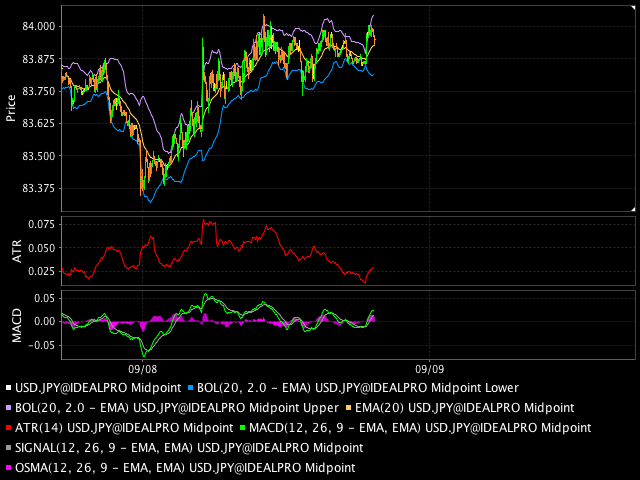
I do feel a bit like Alice. TheUSD/JPY pair rallied in London and New York trading after selling off in Asian trading. The FX rate established a new 15-year low during the session, trading down to levels of 83.35. I took profits on the pop, during morning U.S. trading, around 84.00 levels. Prices recovered when Finance Minister Yoshihiko Noda 'said he is prepared to take “bold” steps on currencies if necessary.' However, I am contemplating a long position in the Yen until 82.50. I watched the tape for the majority of the past 48 hours (fun times) to get a feel for directionality. I am confident prices will move lower.

Part of me wants to believe all of this intervention talk, led by PM candidate Ichiro Ozawa, will lead to more 'normalized' price levels (i.e. 88-90). However, my sinister half believes this was a short-covering rally today. In the ten minutes preceding the Beige Book announcement the pair came to an abrupt slow down in trading. Once the words 'decelerated growth' were uttered on CNBC prices gapped down to 83.79-81. During President Obama's 'Economic Speech', shortly thereafter, prices jumped back up to 83.92-95 levels. Hence, U.S. economic speak was not a significant momentum catalyst, net of direction, for the pair.


JPY 2day chart- 5 minute bars


Will the tape top out at 84.125 resistance levels? What has changed over the past 48 hours to stunt the momentum of a six month downtrend in the USD/JPY pair? Clearly, many uncertainties and rapid-fire change engulf trading. Thus, I look to a glut of international economic data releases that may potentially impact price directionality:

19:50- JPY BSI Large Manufacturing Conditions
01:00- JPY Household Confidence
02:00- JPY Machine Tool Orders
02:00- German CPI (MoM)
04:30- ECB Monthly Report
07:00- BoE Interest Rate Decision
08:30- U.S. Trade Balance
08:30- U.S. Initial Jobless Claims
19:50- JPY GDP(QoQ)
19:50 BoJ Monetary Policy Meeting Minutes


If I have learned one thing in my short few years of trading it is, 'don't trade against the tape.' I will leave you with some wise words from Adam Smith:

"The chance of gain by every man is more or less overvalued, and the chance of loss is by most men undervalued and by scarce any man who is in tolerable health and spirits valued more than it is worth."

Patrick M. Ambrus
Twitter: AnalyzeCapital

---------------------------
USD/JPY = 93.9150 as of 19:37 EST. The 'Matrix' theme for this post was inspired by a fellow trader of mine, Sauros, please view his blog: http://blog.thelordoftrading.com/2010/09/welcome-back-to-real-world-neo.html. Yoshihiko Noda quote was borrowed from Bloomberg.com.

Wednesday, September 1, 2010

Illustrious Imperfections


This evening I was perusing FT's Alphaville blog and came across a great piece written by Mohammed El-Erian. The PIMCO Chief Investment Officer breaks down Bernanke's speech from Jackson Hole.

Link:http://ftalphaville.ft.com/blog/2010/08/27/328906/el-erian-how-to-read-bernanke%E2%80%99s-jackson-hole-speech/

Some questions for the FED

El-Erian alludes to some great points....

1. Is the FED over-estimating its 'grip' on the U.S. economy?
2. What happens when Treasury purchases become the new norm?
3. How does the FED's current monetary policy measures stack up against those of other central banks (ECB, BoE, and BoJ)?
4. The main question that trumps all, is the FED comfortable maintaining a $2 Trillion Balance Sheet over the next 10 years?
4a. If yes, will Quantitative Easing become the new tool to re-inflate economies?

Seems to me 'Helicopter Ben' did his homework on the lost decades in Japan.

Patrick M. Ambrus
Analyze Capital LLC
Twitter: AnalyzeCapital

Tuesday, May 25, 2010

Existing Home Sales- 05.24.2010


Via Bloomberg:

April's expiration of second-round stimulus fed a 7.6 percent jump in existing home sales to a 5.77 million annual rate. But, in a big disappointment, supply on the market jumped 11.5 percent to 8.4 months. Heavy supply together with the absence of stimulus point to the risk of price erosion in the months ahead. But at least for April, prices did firm, up 2.1 percent to a median $173,100.

Details show comparable gains for both single-family homes, up 7.4 percent, and condos, up 9.1 percent. The Northeast led the regional breakdown while the West lagged.

Uncertainty over the housing outlook is a key negative for the economy. Should the jobs recovery weaken, foreclosures and distressed sales could make for new trouble in the housing sector. Stocks firmed off session lows following today's report. New home sales for April will be posted on Wednesday.

I am interested to see how the Fed incorporates these statistics into winding down their QE policy. Specifically, I am speaking about the sales of MBS which have helped bloat the U.S. Central Bank's balance sheet. Wednesday brings new home sales.

I was in Boston today taking in State Street. It does not have the outright intensity or ubiquity of Wall Street. However, the feeling of deal making still looms on State Street. This evening I saw an epic Celtics vs. Magic game 4 of the Eastern Conference Finals. The C's lost, but then again I am a Knicks fan...


Patrick M. Ambrus
Managing Partner
Analyze Capital LLC
Twitter: AnalyzeCapital

Tuesday, May 4, 2010

RBA Interest Rate Decision- 05.04.10


At its meeting today, the Board decided to raise the cash rate by 25 basis points to 4.5 per cent, effective 5 May 2010.

Recently, forecasts for world GDP growth have been revised up again, and growth is expected to be at trend pace or a little above in 2010. Conditions in Europe remain quite weak, though recent data suggest growth is becoming more established in North America. In Asia, where financial sectors are not impaired, growth has continued to be strong, contributing to pressure on prices for raw materials. The authorities in several countries outside the major industrial economies have now started to reduce the degree of stimulus to their economies.

Global financial markets are functioning much better than they were a year ago, but sovereign risk concerns have escalated significantly in Europe over recent weeks. This has prompted additional efforts by policymakers to put fiscal policies onto a sounder footing and to provide support for Greece in the near term. To date, there has been very little contagion outside Europe.

Australia’s terms of trade are rising by more than earlier expected, and this year will probably regain the peak seen in 2008. This will add to incomes and foster a build-up in investment in the resources sector. Under these conditions, output growth over the year ahead is likely to exceed that seen last year, even though the effects of earlier expansionary policy measures will be diminishing. The process of business sector deleveraging is moderating, with business credit stabilising and indications that lenders are starting to become more willing to lend to some borrowers, though credit conditions for some sectors remain difficult. Credit outstanding for housing has been expanding at a solid pace. New loan approvals for housing have moderated over recent months as interest rates have risen and the impact of large grants to first-home buyers has tailed off. Nonetheless, at this point the market for established dwellings is still characterised by considerable buoyancy, with prices continuing to increase over recent months.

Recent data on inflation confirm that it has declined from its peak in 2008, helped by a noticeable slowing in private-sector labour costs during 2009, the rise in the exchange rate and the earlier period of slower growth in demand. In both underlying and CPI terms, inflation over the most recent 12 months was around 3 per cent. Nonetheless, the extent of decline from here may not be quite as much as earlier forecast and inflation now appears likely to be in the upper half of the target zone over the coming year.

With the risk of serious economic contraction in Australia having passed some time ago, the Board has been adjusting the cash rate towards levels that would be consistent with interest rates to borrowers being close to the average experience over the past decade or more. The Board expects that, as a result of today’s decision, rates for most borrowers will be around average levels. This represents a significant adjustment from the very expansionary settings reached a year ago.

The Board will continue to assess prospects for demand and inflation, and set monetary policy as needed to achieve an average inflation rate of 2–3 per cent over time.


(Comex Aluminum, weekly)

China grew at a pace of 11.9% in the 1st quarter of 2010. It is no coincidence that as China shifts to consumption to bolster growth instead of exports, Australia and other Asia Pacific countries will see benefits. In addition, the run-up in the price of Aluminum has surely bolstered Australian exports. Hence, growth in Australia is alive and well.

Patrick M. Ambrus
Managing Partner
Analyze Capital LLC
e-mail:ambrus.anlzgroup@gmail.com

Thursday, March 18, 2010

Consumer Price Index A.K.A. Inflation


Temporarily soft energy costs pulled down the headline CPI for February while weak shelter costs kept core inflation very sluggish. Overall CPI inflation for February eased to no change from 0.2 percent the month before. The latest came in just below the market forecast for a 0.1 percent uptick. Core CPI inflation rebounded a modest 0.1 percent, following a 0.1 percent dip in January and matching consensus expectations. A number of weak components point to the fact that inflation pressures, indeed, are subdued. Shelter costs were flat in the latest month while declines also were seen in apparel and recreation.

Looking at detail, the energy component of the CPI declined 0.5 percent in February after jumping 2.8 percent the month before. Gasoline temporarily eased 1.4 percent, following a 4.4 percent jump in January. Food inflation slowed in February to 0.1 percent from 0.2 percent in January.

Year-on-year, overall CPI inflation fell to 2.2 percent (seasonally adjusted) from 2.7 percent in January. The core rate was slipped in February to 1.3 percent from 1.5 percent the month before. On an unadjusted year-ago basis, the headline number was up 2.1 percent in February while the core was up 1.3 percent.

Today's report leaves a lot of room for the Fed to keep rates low for some time. On the news, Treasury yields edged down and equity futures rose slightly. At the same time, initial jobless claims came in very close to expectations.


My only take from this report is that the economy is not inflating. Meaning QE will likely remain in some form until the Fed raises rates.

It is a beautiful day in New York. Take some time away from the terminal and get some spring air. I am likely heading up to Newport, RI later tonight. Enjoy the rest of the trading week.

Thursday, March 4, 2010

Mr. Trichet Speaks to the Masses- 03.04.2010


"If there's one thing I learned in prison it's that money is not the prime commodity in our lives... time is."
--Gekko, MNS


Highlights from ECB President Jean-Claude Trichet’s Statement

Rates remeain unchanged at 1.00%


Euro Zone Inflation and Growth

•Inflation expectations remain firmly anchored inline with the Governing Council’s aim of keeping inflation rates below, but close to, 2% medium term

•2010 Inflation forecast .8% to 1.6%

•2011 Inflation forecst .9% to 2.1%

•Euro area has continued to benefit from significant macroeconomic stimulus

•2010 GDP growth forecast .4% to 1.2%

•2011 GDP growth forecast .5% to 2.5%

•Loans to non-financial corporations can be expected to remain weak for some time after economic activity has picked up

•We expect price stability to be maintained medium term, supporting the purchasing power of euro area households


Quantitative Easing

•We decided to continue conducting both the main refinancing operations (MROs) and special-term refinancing operations with a maturity of one maintenance period as fixed rate tender procedures as long as necessary

•The Governing Council will continue to implement phasing-out of the extraordinary liquidity measures

•Banks should use improved funding conditions to strengthen their capita; bases and take full advantage of government support for recapitalization


Greece and The PIIGS

•High levels of public deficit and debt place an additional burden on monetary policy and undermine Stability and Growth Pact as a key pillar of Economic and Monetary Union

•All countries will be required to meet their commitments under excessive deficit pressures


Conclusion

•Key challenges in order to reinforce sustainable growth and job creation is to accelerate structural reforms

•Sound balance sheets, effective risk management and transparent, robust business models are key strengthening banks and ensuring access to finance


This commentary is similar to what I read int he Fed's Beige Book yesterday. Economic growth will be slow at best. Inflationary pressures remain subdued. The Central Banks will begin to unwind QE and pull some liquidity from the system.

Patrick M. Ambrus
Managing Partner
Analyze Capital LLC
ambrus.anlzgroup@gmail.com

Morning Updates- 03.04.2010


Good Morning fellow market junkies. Today there is a glut of economic data that should and could potentially give the equity markets some type of direction. Today we will see interest rate decisions from BOE and ECB. I will be looking for any type of details on winding down QE programs. Hence, I want to know when liquidity will start to drain from the system. Also, I want to hear ECB commentary on the sovereign debt problems in Greece and elsewhere. Trichet will probably speak to these issues specifically.

Other Notable Economic Data today:

•05:00 Euro Zone GDP (QoQ)

•08:30 ECB President Jean-Claude Trichet Speaks

•08:30 U.S. Initial Jobless Claims- Forecast (475,000 lost)

•08:30 U.S. Nonfarm Productivity (QoQ)- Forecast 6.2%

•10:00 Canadian Ivey PMI- Forecast 55.00

•10:00 U.S. Pending Home Sales- Forecast 1.7%

•10:30 U.S. EIA Natural Gas Report


BOE Rate Decision

The Bank of England’s Monetary Policy Committee today voted to maintain the official Bank Rate paid on commercial bank reserves at 0.5%. The Committee also voted to maintain the stock of asset purchases financed by the issuance of central bank reserves at £200 billion.


Not too much of a surprise here. Minutes will be released on March 17th.


ECB Rate Decision (Update1)

At today’s meeting the Governing Council of the ECB decided that the interest rate on the main refinancing operations and the interest rates on the marginal lending facility and the deposit facility will remain unchanged at 1.00%, 1.75% and 0.25% respectively.

The President of the ECB will comment on the considerations underlying these decisions at a press conference starting at 08.30 EST today.


I am waiting for some clarity from Trichet before I digest.

Update:

link to full Trichet opening comments: http://www.ecb.int/press/pressconf/2010/html/is100304.en.html


Euro Zone GDP

GDP increased by 0.1% in both the euro area1 (EA16) and the EU271 during the fourth quarter of 2009, compared with the previous quarter, according to first estimates released by Eurostat, the statistical office of the European Union. In the third quarter of 2009, growth rates were +0.4% in the euro area and +0.3% in the EU27.

Compared with the fourth quarter of 2008, seasonally adjusted GDP declined by 2.1% in the euro area and by 2.3% in the EU27, after -4.1% and -4.3% respectively for the previous quarter.


GDP was the weakest in Latvia (-3.2%) and Romania (-1.5%). Estonia had the most robust growth (+2.6%).
Full details: http://epp.eurostat.ec.europa.eu/portal/page/portal/eurostat/home/

U.S. Jobless Claims (update 2)

In the week ending Feb. 27, the advance figure for seasonally adjusted initial claims was 469,000, a decrease of 29,000 from the previous week's revised figure of 498,000. The 4-week moving average was 470,750, a decrease of 3,500 from the previous week's revised average of 474,250.

U.S. Non-Farm Productivity (QoQ) (update 4)

Both productivity and costs were revised better than expected for the fourth quarter. Businesses clearly are focusing on cutting labor costs to try to boost profits or cut losses. Nonfarm business productivity was revised up to a sharp 6.9 percent boost from the initial estimate of 6.2 percent. This followed a revised 7.8 percent surge in the third quarter. Today's report includes annual revisions which raised the Q3 figure. The consensus had called for a 6.3 percent revised gain for the latest period. Unit labor costs fell an annualized 5.9 percent in the fourth quarter, compared to an initial estimate of minus 4.4 percent and a revised third quarter plunge of 7.6 percent. The market forecast was for a 4.5 percent drop in costs.

U.S. Pending Home Sales Index (Update5)

The Pending Home Sales Index,* a forward-looking indicator based on contracts signed in January, fell 7.6 percent to 90.4 from an upwardly revised 97.8 in December, but remains 12.3 percent higher than January 2009 when it was 80.5.

Lawrence Yun, NAR chief economist, said weather is likely to impact housing data. “January pending sales, though still higher than one year ago, remain much lower than expected given that a large number of potential buyers are eligible for the expanded home buyer tax credit. Moreover, the abnormally severe and prolonged winter weather, which affected large regions of the U.S., hampered shopping activity in February,” he said.


Nat Gas Inventories (Update 7 last one)
Working gas in storage was 1,737 Bcf as of Friday, February 26, 2010, according to EIA estimates. This represents a net decline of 116 Bcf from the previous week. Stocks were 71 Bcf less than last year at this time and 21 Bcf above the 5-year average of 1,716 Bcf. In the East Region, stocks were 9 Bcf below the 5-year average following net withdrawals of 74 Bcf. Stocks in the Producing Region were 24 Bcf below the 5-year average of 604 Bcf after a net withdrawal of 27 Bcf. Stocks in the West Region were 54 Bcf above the 5-year average after a net drawdown of 15 Bcf. At 1,737 Bcf, total working gas is within the 5-year historical range.

Natural Gas sold off after this report was released.


Quotes

Foreign Exchange
-EUR is down -0.2775% against the USD @ $1.3657 as of 9:36 EST.
-EUR is up 0.4666% against the JPY at 121.66.
-USD is strengthening against the JPY by 0.6327% @ 89.0650.
-GBP is up against the USD by 17 basis point at $1.5124.

Commodities
-Gold is down $3.70 sitting at 1139.00/troy ounce
-Silver is off 37 bp @ $17.265/t oz.
-WTI Crude is down $0.56 this morning to $80.31/barrel
-Nat Gas is down @ $4.72/MMbtu

Equities

Asia (closed)
-Nikkei 225- off -1.05% @ 10,145.72
-Topix- down 8.01 points to 897.64
-Hang Sang- off -1.44% to 20,575.78
-S&P/ASX 200- down 14.80 point @ 4750.50
-CSI 300- down 84.51 points to 3250.57

Europe
-FTSE 100- 5521.31 off -.22%
-CAC 40- 3833.06 down -.25%
-DAX 30- negative by 21.40 points @ 5796.48

United States
-Dow Jones- up 25.32 points @ 10,422.08 (as of 09:30 EST)
-NASDAQ- up .14% @ 2283.94
-s&P 500- up 2.9% to 1121.99


Bonds
-UST 10 Y- Price: off .035 to sit at 99 30/32 Yield: 3.63%
-Bunds 10 Y- Price: off .047 to 100.89 Yield: 3.14%
-JGB 10 Y- Price: rallied .044 to 100.57 Yield: 1.34%


I will try and Update this throughout the trading day

Good luck trading


Patrick M. Ambrus
Managing Partner
Analyze Capital LLC
ambrus.anlzgroup.gmail.com

Sunday, February 14, 2010

U.S. Economic Report- 02/14/10


2010 U.S. Economic Outlook: USD Implications

Growth Coupled with Dollar Strength

•The USD has room to strengthen against all G10 currencies since those currencies were overvalued against the USD by an average of 5.6% in 2009

•The U.S. economy grew by 5.7% in the 4th quarter of 2009 as interbank spreads narrowed, Equity, and corporate debt markets have rallied signaling a stronger dollar and return to normal growth

•Industrial output declined by 970 basis points in 2009,but is forecast to grow by 620 basis points for the year 2010, thus signaling a rebound in manufacturing and perhaps job creation

Inflation Story

•The U.S. Treasury, Federal Reserve, and FDIC have pumped enormous amounts of Liquidity into the Capital markets throughout the Great Recession in the form of Tarp, Stimulus Packages, PPIP, Legacy Securities Program, TALF

•The BOE and ECB are likely to tighten monetary policy before the FOMC because The U.S. federal Reserve will most likely keep interest rates unchanged in 2010 due to The Committee’s responsibility of handling Inflation and Unemployment

•Consumer Price Index Inflation declined by -0.4% in 2009 and is expected to increase to an average of 2.1% in 2010

Unemployment and Fiscal Deficits

•United States unemployment peaked in 4th quarter of 2009 at 10.0%, with nearly 8.4 million people out of work since the beginning of The Great Recession. The unemployment rate for 2009 was 9.28% and is expected to grow to 9.60% in 2010

•The Current Account deficit as a percentage of GDP widened to -3.0% in 2009 and will amplify to -4.0% in 2010

•The 2009 budget Deficit in the U.S. is expected to be $1.42 trillion which represents 9.98% of Gross Domestic Product


USD Drivers


Balance of Payments
The U.S. maintains a current account deficit of -3.0% as a percentage of GDP and is expected to grow to 4% in 2010. This can be attributed to 2009 net exports of -354 Billion. Also, the U.S. sees investment inflows into their equity and debt markets to offset such a large trade gap. China invested $790 billion in U.S. Treasuries as of November 2009. Fundamentally, this goes a long way of explaining long-term dollar weakness.

Growth
The United States Economy grew by 20 basis points in 2009 boosted by 4th quarter GDP output of 5.7%. This signals a return of demand to the world’s largest economy. Much of the growth story can be attributed to the excess liquidity put into the system by the Fed’s quantitative easing programs and government stimulus package. Additionally as The S&P 500 rallied 70% off the lows of March 2009 to January 2010, consumers have reason to spend as their net wealth increases even in the face of continuous declining real-estate values. In addition, Industrial output surged 700 basis points in the 4th quarter of 2009 to contribute to GDP growth. However, one caveat remains; U.S. unemployment remains at 9.7% currently and is expected to be flat with moderate increases/decreases in 2010. It is hard to justify an economic recovery without job growth. Though the Euro area has greater difficulties with unemployment.

Deficit
The 2009 budget Deficit in the U.S. is expected to be $1.42 trillion, which represents 9.98% of Gross Domestic Product ($14 trillion). Careful maneuvers will decrease the 2010 fiscal deficit to $1.14 trillion or 8.02% of GDP. According to John Maynard Keynes deficits can be have a positive economic influence by helping economies climb out of recession.

Inflation
The United States saw deflation in 2009 as CPI decreased by 40 basis points on average. Inflation is expected to pick back up in 2010 by 2.1%. However, the Federal Reserve will surely act quickly to spur inflation. The lesson was learned last go around when Alan Greenspan kept The Fed Funds rate at low for a historic period. This helped fuel the Credit crisis. Additionally, tightening monetary policy would increase the value of the dollar global and kill any potential dollar carry trade.

Interest Rate Differentials
Currently a 10 Year U.S. Treasury yields a nominal rate of 3.625% and a real rate after inflation is accounted for of 3.925%. The U.S. nominal 10 year rate beats out 10 year German Bunds yielding a nominal rate of 3.25% and 10 year Japanese Government Bonds with a nominal rate of 1.3%. Also, Bunds and JGB on average yield real rates of only 2.95% and 2.6% respectively. This has positive implications for dollar strength.


Patrick M. Ambrus
Managing Partner
Analyze Capital LLC
ambrus.anlzgroup@gmail.com

Monday, January 25, 2010

Death of The Investment Bank


United States President Barack Obama proposed on Thursday a novel set of stringent restrictions his administration plans to implement in order to exile “risk” from Wall Street. The new directives include limiting Prop Trading, restricting investment in Hedge Fund and Private Equity groups, and curbing the size of an individual bank based on deposits.

"You can choose to engage in proprietary trading, or you can own a bank, but you can't do both," an administration official said. Do these same rules apply to Credit Agricole, Deutsche bank, Société Générale, UBS, Credit Suisse, Barclays, HSBC, ING Group, RBS, Mitsubishi UFJ Financial Group, etc…? This much is not yet clear. However, one can presume the answer to be no. So then why is Washington hell-bent on wringing out U.S. based financial institutions? U.S. banks received “bailout” money from the infamous Troubled Asset Relief Program. Let’s examine the “Tarp” for a moment.

As of February 9, 2009, $388 billion had been allotted, and $296 billion spent, according to the Committee for a Responsible Federal Budget


Of these banks, JPMorgan Chase & Co., Morgan Stanley, American Express Co., Goldman Sachs Group Inc., U.S. Bancorp, Capital One Financial Corp., Bank of New York Mellon Corp., State Street Corp., BB&T Corp, and Bank of America have repaid TARP money. Most of these have been done with capital raised from the issuance of equity securities and debt not guaranteed by the federal government.

The largest outstanding Tarp repayments come from AIG, General Motors, GMAC, and Chrysler. So I ask the question: “Are any of these companies Bank holding companies? Back to my original question: Why has the Obama Administration harped on Bank holding Companies?

The answer is quite simple. It builds political capital. The new administration has struggled time and again to justify spending $787 B in stimulus money, Health care overhaul with a public option, the war in Afghanistan, and most importantly create jobs. Many Americans remain unemployed, more than 10%. When those Americans read Goldman Sachs makes record profits and allocates funds for record payouts, anger and frustration ensue.

Also, even the most educated American does not understand what an Investment Bank does or its purpose in the global macro economy. Hence, it is easy for President Obama to say "Never again will the American taxpayer be held hostage by a bank that is too big to fail." What bank is holding us hostage? As the above chart indicates most all Banks with the exception of few smaller players have repaid Tarp funds with dividends. For example, Goldman Sachs paid a $1.3B dividend. Not to mention, The Federal Reserve is sitting on billions of dollars in paper profits from its controversial effort to unwind credit insurance contracts that AIG provided to banks such as Goldman Sachs.

However, there is no news like bad news. I point the finger at the media in this case for failing to educate the general public with these headlines. Yet, it is not all their fault. The Global Financial System barely dodged the Asteroid that could have been the trigger to a greater Apocalypse. I do agree that reform, new regulation, and risk management need to be considered in order to prevent things from spiraling out of control again. Though, I am disappointed that Washington officials are spinning this for personal reasons rather then taking the time to educate Americans on the causes of the crisis.

What will happen to the once ironclad Investment Banking model going forward? It is hard to say. Surely, lobbyists will be hired and lawsuits will arise. Not to mention regulation takes years to truly make an impact. One thing is for sure; this is a dangerous game of Liar’s Poker.


Patrick M. Ambrus
Analyze Capital LLC
Managing Partner
ambrus.anlzgroup@gmail.com

Monday, December 14, 2009

Dress For Success- 12/14/09


"I don't throw darts at a board. I bet on sure things. Read Sun-tzu, The Art of War. Every battle is won before it is ever fought. "

--Gekko


Econ Data for the week. I left out housing starts as well as energy numbers. I will blog on them if I have time later.


Tuesday:


PPI


Producer Price Index comes in tomorrow morning at 8:30. I am particularly interested in seeing the finished goods data. This should give investors enough information to gauge overall growth in the economy. Also, if numbers come in better then expected we can look for a continuing trend in CPI. Hence, putting pressure on the Fed to raise rates. However, that probably will not happen any time soon. Just wishful thinking. Look for Dollar strength if the numbers are good.


Via Bloomberg:

Market Consensus Before Announcement

The producer price index increased 0.3 percent in October after dropping 0.6 percent the month before. The rise in the latest month was led a 1.6 percent boost in energy and a 1.6 percent gain also for food. But at the core level, the PPI rate unexpectedly dropped 0.6 percent, following a 0.1 percent dip in September. The fall at the core level was due mainly to declines in prices for light trucks and passenger cars. Looking ahead, there is still upward pressure on the headline figure from higher oil prices. Imported petroleum prices were up 6.2 percent in November. Also, seasonally adjusted spot prices for West Texas Intermediate increased 6.9 percent for the month.


Industrial Production

If the numbers show economic growth look for this to spur a sell off in Treasuries.


Bloomberg:


Market Consensus Before Announcement Industrial production in October edged up only 0.1 percent, following a 0.6 percent boost the prior month. However, the manufacturing component declined 0.1 percent, following a 0.8 percent jump in September. Overall capacity utilization in October continued its rise from the historical low set in June, posting a gain to 70.7 percent from 70.5 percent in September. Looking ahead, earlier-released manufacturing indicators mostly suggest improvement in industrial production for November. From the employment situation, production worker hours in manufacturing were up 0.4 percent for the month. Key manufacturing surveys were in positive territory for November-including ISM, Philly Fed, and Empire State.


Wednesday:


CPI

Any inflation on the horizon? This number coupled with bullish PPI could re-fuel the St. Nick rally.


Bloomberg:


Market Consensus Before Announcement The consumer price index in October firmed to a 0.3 percent boost after rising 0.2 percent the month before. Core CPI inflation was unchanged with a 0.2 percent increase. Boosting the headline number was a 1.5 percent jump in energy prices. Food price inflation was restrained in October with a 0.1 percent rise. Looking ahead, there is still upward pressure on the headline figure from higher oil prices. Imported petroleum prices were up 6.2 percent in November. Also, seasonally adjusted spot prices for West Texas Intermediate increased 6.9 percent for the month.


Fed Decision


I want to know when Bernanke plans to wind down QE or if there is even a plan in place for this. Specifically I want clarity Mortgage backed asset purchases program. How will the Dollar react? Does the FOMC support recent USD strength?


Thursday:


Initial Jobless Claims

Will we see 5/6 positive weeks or a second consecutive week of losses?


Bloomberg:


Market Consensus Before Announcement Initial jobless claims for the December 5 week ended five weeks of improvement, rising 17,000 to 474,000 for the highest level since mid-November. But the four-week average improved, dropping 7,750 to 473,750. Continuing claims in data for the November 28 week fell very sharply, down 303,000 to 5.157 million. The drop in continuing claims reflects an uncertain mix of new hiring and the expiration of benefits.


Patrick M. Ambrus

Analyze Capital LLC

Managing Partner

ambrus.anlzgroup@gmail.com


Monday, November 23, 2009

Ignorance Is Bliss-11/23/2009


Re-Blog via Bloomberg:

What is the fate of Quantitative Easing? Today Federal Reserve Bank of St. Louis President James Bullard claimed the Fed should expand on QE past March. “Initially it would do nothing for the economy, but it would give the Fed the option to react to future news as it comes in,” Bullard said.

Additionally he stated, “If the economy came in very weak, let’s say, in 2010, weaker than expected, we would have the option of doing further quantitative easing” through additional asset purchases. “If the economy came in stronger than expected and inflation expectations started to ratchet up a little bit we could maybe sell off some of these assets and remove some of the accommodation from our quantitative easing program.”


Bullard also explained, The FOMC is not averse to hiking interest before unemployment cools, “We know the economy changes over time. Everybody’s got very strong opinions and takes the role very seriously. I don’t think anybody would feel bound just because we behaved.”


Thoughts:

Naturally, I am not sure what message the Fed is trying to convey to open markets. Every FOMC meeting of recent memory has lacked any type of clarity on interest rate policy. Yet Bernanke, Summers, and Geithner remain to back a strong USD.

On top of all this political banter Ron Paul's bill to regulate the Fed appears to have legs. As I have discussed with my partner Alex, The Fed is split. There is no unification. A disjointed front leads to two things: 1. Power Struggle 2. Defeat.

Monday, November 9, 2009

Commercial Realestate Looks Promising


Since the ides of March global equity markets have outperformed like never before. Yet consumer credit, small business loans, and interbank lending remain wedged in a tight pair of skinny-jeans . Perhaps this nugget may help decipher the phenomena. You be the judge.


Patrick M. Ambrus
Analyze Capital LLC
ambrus.anlzgroup@gmail.com

Tuesday, June 30, 2009

"Chinese Credit Growth" - July 2, 2009

"Chinese equities may well be being fueled by excessive domestic credit growth" -Phil Suttle

Here is an interesting quote I took from a market commentary by Phil Suttle head of Global Marco Analysis at the IIF (The International Institute of Finance).

I question the validity for such a line of thought. Recently I have been creating an emerging bank database. Yesterday I covered the top 4-5 largest banks in China ( ICBC, China Construction Bank, China Agricultural Bank, and Bank of China; some of the largest banks in the world as well)

Most of these banks only started publicly being traded Mid 2008, but from what I remember, I believe most of their assets were deposits and that the loan to deposit ratio is relatively small. With much more deposits to loans, "explosive" credit lending may be more sustainable.

Having a discussion with Suttle this morning, he pointed out to me that much of these increases in money supply are from monetary injections, though on a whole deposit still make up a significant amount. High credit growth in China according to a Monetary Authority statement may be "worrisome."

Though one can counter and point out that high credit growth is quite normal in emerging markets. I could attest to this as I experienced such an environment when working in HSBC Vietnam during the summer 2008. There was massive amounts of high inflation (in the high teens and 20's), near currency crises issues (exporter hoarding dollars, lack of dollar liquidity), extreme interest rates(in the high teens), along with explosive credit growth. I would also like to note that there were barriers on foreign banking institutions at the time (e.g. foreign banks were still waiting to be incorporated locally; one can imagine the hypothetical credit growth with foreign banks allowed to incorporate locally).

My point is that high credit growth is a natural phenomenon seen in industrializing nations when there is high exuberance in investment and investment return sentiment. What is truly important is if the Monetary Authorities are aware of the exponential credit growth and reign in expectations and at the same time implement corrective monetary controls to make credit growth sustainable (I was actually quite pleasantly surprised with the Vietnamese Authority's ability to handle their economic situation last summer).

With these points in mind, as I mentioned before, loan to deposit ratios may make the Chinese credit growth more sustainable, and it seems that the Chinese Monetary Authorities are aware of the growing credit situation. Though, these two latter points tend to be contradicting with China's trade policy. Considering 40% of China's GDP is exports, this recession has severely reduced GDP growth as US consumption has dropped significantly (a drop in Chinese exports, an increase in US savings rates, and increase in US domestic retail recently reported). Chinese authorities are stubbornly and quite possibly dangerously suppressing their currency further in order to strain the economy for 8% GDP growth.

Currently, I would say that credit growth is sustainable, though if Chinese Authorities try to keep pushing for higher GDP growth in this recessionary environment, there is a chance they may allow credit growth to get out of control (e.g. more lending for corporates to grow business vs organic growth).

In consideration of China as a whole, outside the highly modernized cities, most of China requires huge infrastructure developments. That the amount of room for pure organic/commercial/extensive growth has HUGE potentials for commercial banking, once the right infrastructure is in place. For the Authorities to allow loan led economic growth would be ridiculous given the amount of room for extensive growth. Excessive credit growth in this view would only be sensible if credit growth was allowed only for infrastructure developments, which in turn would allow for FDI and Business loans to be dispersed into the economy.

Taking a more obtuse view of things, this current world recession is a positive occurrence for emerging markets. Long term prospects of emerging markets have not been blown away by this recession. Currently, developing nations are dealing with their own problems, which makes investing abroad secondary at the moment. This is great for emerging markets, since over the last few years emerging market growth has been explosive. When the United States fell, soon followed the rest of the world. As so, this gives investment exuberance a chance cool down and restart at a more reasonable pace (double digit growth in GDP is not sustainable for prolonged periods as history has shown us; e.g. look at the so called "Japanese miracle," Singapore, Thailand, and more recently Vietnam etc...). This recession allows for less chance of investor expectations being failed which could have lead to capital flights out of the country, severely damaging long term growth (something reminiscent of the Asian currency crisis).

One can view this recession as a period for emerging markets to cool off and take a break before resuming on its path of industrialization. Another implication from this recession is that, since emerging markets are only on a "break", it maybe the emerging markets that lead this way out of the recession followed by their more developed counter parts.

Furthermore, if the Chinese Authorities or other export oriented nations are smart they may try to diversify away from exporting to the US (this move has been seen as China trying to politically push for a new reserve currency: check this article out found by my colleague Pat China and Argentina in currency swap; I will say one thing about a new reserve currency, this maybe impossible for China to get off the dollar even if there was a new reserve currency considering the amount of US debt they hold; further more I'm sure the US would use their political muscle to prevent these scenarios from happening). Ideally, if China can diversify their export partners, this recession may not take such a strong toll on their growth.

An even better idea would be for China to take this "cooling off" period and focus on infrastructure development to foster domestic and intensive growth vs. export oriented growth (look where exported growth led Japan...).

With this being said, at least as of now the credit markets in China may not be as bubbly analyst are speculating. Though the commodity markets may be, but that is a different story...


I actually do not know much about Chinese economic development so hopefully I can take the course at the LSE next year about the "LONG economic history of China." I will certainly be looking forward to that.


-Alex

Wednesday, October 29, 2008

Entry for 10/29/08

As usual, I do like to comment on the Fed Reserve. I must say again, I am disappointed in decision making policy coming from the US federal reserve. Another rash decision of cutting rates pushing rates to 1%, I find this quite rediculous. People argue the Fed is doing this for lidiquity I may give some leeway to that arguement, but I will not accept the fact that the Fed is doing this to "restore confidence" for investors. The Fed Reserve has strayed far from its jurisdiction to an extent, though, yes indeed this is systemic, but should they be taking the lead in trying to fix this mess we are ?

What needs to be changed is underlying fundmentals, real change in the structure of systems in place. All the systems need to be reassesed in order to find a better solution to the current "crisis" we are in. Dumping lots of money into markets with a bunch of skiddish investors will solve no problems. With a sound system in place that people can trust will take some what years to accomplish. I feel that many investors (middle class investors) have been scarred from event from the early 2000's, and feel they are reliving the past. Many pension funds and 401ks are taking hard hits, while some are holding cash now some are biting the bullet and waiting it out (though if there are a large number of people in cash positions, this may have large implications to come in the future, but I will have to discuss this later) After the 2000 crash, Sentiment probably wasn't restored about 2 and half years later after the crash as this is reflected in Fed Fund rate cuts shown against performance of the S&P500.

If one were to follow previous Fed policy in the past we will see that Janurary 3rd 2000, Fed Fund rate was cut from 6% to 5 and 1/2. Soon after that 1 about year later on Dec 11 Fed Funds rates were cut to 1 3/4. This was not even enough to restore confidence in investors as the S&P500 continued its slide all the way up until around march 2003. Prior to March before the S&P500 started its 4 and 1/2 - 5 year rally, the Fed Fund rate was cut to 1.00. Considering long trends, cutting rates so low was quite ineffective. Some will argue that Greenspan was at fault for our current situation from such policy decisions. Though, I do not suscribe to such a belief, there is some truth to it. From what I can tell 1.00 in the Fed Fund rate is way below the average (though I would have to calculate the averages from all the times the Feds Changed rates which the available data ranges from 1971 - 2008, which I have not done. Wheather or not this is an acurate average or a statistical blunder I am not sure, though Im sure we can pull some general truths from it). 1.00 is below the average and has been only seen at times when there have been crisis. If indeed, people want to believe that Greenspan is at fault for our current situation, I think everyone should be extremely worried now. Whereas in it took about 2 and half years to reach 1.00 Fed Fund rate from 6.00 from the 2000 crash. Bernake may manage to get rates from 5.25 June, 29 2006 (the begginings of the subprime problem)to 1.00 in 2.3 years. If one were to actually use the more dramatic effects of the credit crisis as a starting point, the rate at which bernake has cut rates has been much higher than greenspans cuts. Also, I would like to note that over the 2 and half years of cutting, the S&P500 has a more gradual down trend, while in 2006 to 2008 we have an uptrend, and then from the start of 2008 to october 2008 we have a sharp drop. The different trend patterns may suggest that one cannot compare the two crisis accurately in order to predict market performance. Though it is possible to gauge investor behavoir based of policy.

As we saw in the past crisis of 2000, investor confidence may not have been restored based off rate cuts and may have been something that needed to be fixed over time. This may suggest Bernake should not be cutting rates at this point, as it will be ineffective, in a matter of time fundamentals will improve themseleves. From a historical perspective Fed Fund rates at 1.00 maybe too much and something below the average (whatever that may calculated to be) and holding rates there might be more effective as it might stave off uncessary future crises since rates would not be extremely low at the point of causes future crises.

Though on considering the difference performances in the S&P500, such a fast drop in the index may mean a faster recovery. Though this will have to be examined at a different time...

** I will have to reorganize or summarize this later as my arguement may not be clear or organized well enough for comprehension.
 
Disclaimer
This Blog has been developed by Analyze Capital LLC, and as an independent organization we provide “AS IS” information without warranty. The ideas and opinions expressed by the contributers of this blog are personal and do not represent the actions or policies of Analyze Capital LLC. The contents of this blog do not intend to assert recommendations or to offer advice of any kind. We are not responsible the consequences, be they gains or losses, that may result from using any of the information from this blog.