rss
email
twitter
facebook
Showing posts with label Foreign Exchange. Show all posts

Tuesday, October 19, 2010

Hurricane China Watch


22:40- Commodity Update

WTI CL- November ‘Crude oil rose, recouping part of the biggest loss in eight months, as China’s interest rate increase added to signs of economic growth and analysts forecast a decline in U.S. fuel stockpiles. Futures gained as much as 0.4 percent after dropping 4.3 percent yesterday, the biggest decline since Feb. 4.’

November Crude trades at $79.90/b up $0.30. December Crude trades at $80.50/b up .37%. Globex shows December contract volume of 4.8k. Due to impending expiration on Wednesday, November crude only traded 481 contracts as of writing.

‘The Energy Department report today may show U.S. gasoline inventories fell 1.5 million barrels, according to the median of 16 analyst estimates in the Bloomberg News survey.’ (Bloomberg.com)

Natural Gas- NG contracts expiring on October 27 continue to pick up traction from yesterday’s session in which prices rallied more than 2%. The front month contract is up by .51% to 3.538.

GC- Gold was crushed in yesterday’s session and traded down by $40 on December contracts. The precious metal is up by $3.50 to 1337.10/Toz.

Copper- After trading down to 3.7250 throughout the NYMEX session, HG gained some traction during Globex trading. The Red base metal December contract is up by .94% to 3.7655.

22:30- FX Commentary

EUR/USD- The Euro has weakened a bit since the blood bath, across all asset classes, at the close of NY trading. The pair traded as low as 1.3700 @ 20:00. The slight breach of 1.37 triggered heavy buying up to 1.3750. Since then the pair has bounced and now trades higher by 58 pips from the lows to 1.3758. The pair is up 34 pips on the session.


USD/CHF- The ‘Swissy’ traded down to .9680 at 21:50 from session highs of .97185 at 20:00.  The pair is weaker by 32.5 pips on the session and was last quoted at .9686.
AUD/USD- Watching this pair is almost as much fun if not more fun than the viewing the  EUR/USD trade.  The Aussie dropped to .9665 at 20:00 and paired all losses to touch a session high of.9742 at 21:45.  The pair now trades at .97375.


Trading Economics
Many Commodity traders who held Net long positions may have been caught off-guard when The People's Bank of China explicitly announced hawkish monetary policy in order to curb inflation:
"China's benchmark rates are not an overnight lending rate as is the case in the United States and other major western economies. Instead, it has a one-year interest rate on saving deposits, which increased to 2.5% and a one-year interest rate on loans, which rose to 5.56%." (CNNMoney.com)


GDP, CPI, PPI, Retail Sales, and Industrial Production data are to be released tomorrow evening.  Economists expect the Chinese economy grew by 9.5% yoy in the third quarter of 2010.  Any growth figures over 10% ought to unleash the commodity bulls from the proverbial cage they were placed in today.

-Patrick M. Ambrus

Sources: Bloomberg.com, Economy.com, listown.com, CNNMoney.com

Friday, October 15, 2010

Early Bird Update


00:016- Equity Commentary

The Nikkei 225 is off .52% to 9530. Bloomberg attributes the drop to Investor Sentiment:

‘“Investor sentiment is a bit twitchy,” said Shane Oliver, Sydney-based head of investment strategy at AMP Capital Investors Ltd., which manages $85 billion. “The U.S. data was a bit poor. This week we’ve had a couple of good days and investors may be looking to take profits.”

The CSI is up 2.00% or 65 points to 3,288.52. The ASX 200 is down 13 points to 4686.60.

In the U.S. GE reports before the opening bell on the NYSE: “Analysts project a second straight quarter of higher profit after eight periods in which it declined or was little changed. Adjusted earnings may be 27 cents a share on sales of $37.4 billion, the average of estimates in a Bloomberg survey.”


SPX, Dow, and Nasdaq Futures are flat. 5 and 10 Year Treasury futures are up 0.05% as of writing.

00:05- Commodity Commentary

Energy- Nat Gas is currently positive by $0.0001, up on light volume. November CL contracts have followed the dollar for most of the session. Losses were paired from 82.53. November contracts are up at $82.75/barell.

Precious Metals- Silver has led the rally and is up 1.47% or $0.36 to 24.795. I see $25.00 on Silver before $1400 on Gold. Gold is positive on the session up $3.60 to 1381.30.


Grains- Wheat and Corn continue to rally as we have a global shortage. In addition corn may be benefiting from E15 legislation now in place. Though, bullish activity is in order until the next USDA report reports accurate Supply numbers. The always important yield/acreage ratios remain on the low side when measured against previous estimates. Wheat is up .82% and Corn is up .93% on the session. Additionally, Soybeans continue to extend gains, advancing by 1.20%.

00:00- FX Comentary

EUR/USD- the pair traded down as low as 1.4009 at 20:15. The pair then traded up to 1.4049 and faced resistance at 1.4050. The 'Sovereign Default Trade' seems to have found support in the 1.4025-1.4035 range. Currently we are long at 1.40387.


Cable trade - The pound traded down to 1.5985 at 20:30 and has since traded up around 1.6005. The pair sits at 1.5997 at present time.


U.S. Dollar Index- The DXY gained traction and is trading up to 76.88.

U. S. Trading

CPI , Empire State, and Retail Sales come in at 08:30.  I expect 'robust' retail sales data to bolster equities.  Additionally,  expect a weaker USD tomorrow with stronger Commodities.  Good morning and good luck.

-Patrick M. Ambrus

Sources: Bloomberg.com, Stockcharts.com, The Gartman Letter, Financial Times

Thursday, October 14, 2010

Lost in Transition


As the memories of summer dawn upon us and autumn's head-winds transition us into colder months, we remain stuck in a period of cryptic transition.  The green leaves are slow to transform into  red, yellow, and orange decay.  Throughout September and early October, temperatures here on the Eastern United States remain elevated with splashes of summer, spring, and autumn surprising us on a daily basis.  I seek clarity in these matters.   Moreover, when will a new forceful trend form and carry us into colder, cooler, and darker days?

This same phenomena can be easily applied to current market conditions.  We are at a a cliff looking over the edge and waiting to be pushed by "someone or something."  For the past month of trading the impetus for asset price appreciation came at the behest of the U.S. Federal Reserve.  Mr. Bernanke made it clear at the Fed's anual Jackson Hole Summit:

Notably, since December 2008, the FOMC has held its target for the federal funds rate in a range of 0 to 25 basis points. Moreover, since March 2009, the Committee has consistently stated its expectation that economic conditions are likely to warrant exceptionally low policy rates for an extended period. Partially in response to FOMC communications, futures markets quotes suggest that investors are not anticipating significant policy tightening by the Federal Reserve for quite some time. Market expectations for continued accommodative policy have in turn helped reduce interest rates on a range of short- and medium-term financial instruments to quite low levels, indeed not far above the zero lower bound on nominal interest rates in many cases....


In support of the stock view, the cessation of the Federal Reserve's purchases of agency securities at the end of the first quarter of this year seems to have had only negligible effects on longer-term rates and spreads. 

Many Market participants took statements like these as indicative of greater 'Quantitative Easing' measures in the near-term with an emphasis placed on purchases of longer-term maturing Debt instruments.  Thus, the cruise ship 'QE2' set sail and every trader, analyst, investment banker, and speculator jumped aboard.  The rumors of 'QE2' allowed an appreciation  of equity prices, commodity prices, and a continued rally in the bond market.  However, many market participants fight a potentially painful hangover as they wait for another round of cocktails to tide them over.  Until 'QE2' becomes a reality, the current run-up in asset prices will continue to be predicated on rumors supported by ubiquitous supply & demand, fundamental, and sentimental data.

Consequently, The USD has taken the brunt of the pain over the past month of trading.  The US Dollar Index is down 6.8% in the period from September 1st -October 11.  Even though this downward trend has been in place since early June, the recent rumor mongering has certainly contributed to the Greenback's precipitous plunge in value.


EUR/USD has appreciated by 9% since September 1st.


OK so what, why does a weak dollar matter? As the emerging markets transition into developed economies won't the USD need to allow the wealth to spread to other currencies, 'new reserve currencies'?  In the future, the USD may no longer be the benchmark for which emerging market rates are pegged or for which all central bank reserves pile into.  However, these structural changes will not placate current financial psychology for some years time.  Hence, we must look at the short-term trends to discern directionality.  Disregard, financial profits, journalists, and fund managers who say otherwise.  Trade the trends.  Block out the noise.


-Patrick M. Ambrus

Sources: Stockcharts.com, Federalreserve.gov

Monday, September 27, 2010

Headwinds of Change

Unpredictable Market Forces at Work


After a positive week for U.S. equities, market action lacks directional impetus. What will drive equity markets higher? It is clear to us window dressing season is in full effect. Many fund managers and Institutional Investors continue to pile into crowded, growth-oriented, and alpha-seeking equity trades. In addition, many prominent investment bankers sitting in the position of 'Head of Global Equities', at their respective shops, continue to preach 1300 on the SPX by year end. Is this feasible? Sure, but it is not likely.

Much of the current rally in the SPX from August lows of 1015 has been due to a weaker USD across the board. One can argue the impact of illustrious economic data releases on price swings until blue in the face. Yet, since the fear of debt contagion in the Euro-zone abated panic and worry shifted back on the country with the world's largest Gross Domestic Product. Since then, the EUR, CHF, JPY, and AUD have all made substantial advances against the 'Greendback'.


Down Under


Australia continues to benefit from their trade relationships with Asia in that exports of commodities have led to sustainable growth down under. The economy picked up last month creating 29,000 new jobs predominantly in construction and industrial sectors. As long as Chinese demand for iron ore, copper, and aluminum remains consistent, thE AUD Will continue to appreciate against all major pairs.


Efficiency


The 'Swissy' benefits predominantly from the risk-on/risk-off trade. The linguistically diverse country maintains a current account surplus of 8.9% of GDP, inflation hovers around 1% while unemployment is below a comfortable 4%, and 2011 GDP growth forecasts 2% growth. If one wants safety what is not to like? In addition FX traders seem poised to test the patience of the SNB again. Recall when the SNB stepped in with 'unilateral intervention' and sold Swiss Francs to keep the rate above 1.30 EUR/CHF. Will they sell Francs and buy Dollars? No, the Japanese already failed in this endeavor.


Tradition


The Japanese economy, like the U.S., is struggling to maintain growth. Deflation wanes in the balance and export demand is tailing off in large due to a strong currency and shrinking profit margins at the likes of Sony, Toyota, Bridgestone, and Kobe Steel. With a dire economic situation the MOF stubbornly talks up the JPY and the need for intervention. Though, by 'unilaterally intervening' in the FX markets already traders know the MOF has a gun. The question is how many bullets are in the gun, and does the Ministry possess the courage required to fire a full clip? Time will tell on the latter. I doubt we have seen the last of 'unilateral intervention'. Speculators who place bets in JPY strength will not learn until the MOF reverts back to 2004 tactics and dilutes the market with over $1 Trillion of Yen. Whether or not Kan's $55 B stimulus package helps weaken the JPY remains to be seen.

Lastly, I would like to touch on the political issues underpinning the currency. Since Ichiro Ozowa was ousted in his most recent attempt to gain power, Naoto Kan appeased the former's supporters with currency intervention. I trust the exporters mentioned above took note of this and will put pressure on Kan's administration to intervene again. Many have made it resolutely clear; 'we want USD/JPY rate at 95'. If Kan wants to keep his job longer than his predecessors he will intervene again and again until the Yen stops strengthening.


The Little King of Everything


Alas we have but one more pair to discuss, you guessed it, EUR/USD. As mentioned by Dennis Gartman this morning, 'This was the level from which the EUR plunged earlier this year... it marks almost perfectly the 50% retraetment of the EUR's collapse from the highs of 1.5200 last December to the lows of 1.1900 this spring.' 1.3500 will serve as a hard line of resistance over the next trading session. This morning around 10:00 the pair jumped above this level on a large candle to the upside. However, the pair rocketed back down to the 1.3450 levels within the next hour.

Also, ECB buying of sovereign debt is slowing. Last week the ECB bought only 134 M EUR of bonds in comparison to 323 M EUR the week prior. Maybe the ECB feels confident the liquidity in the sovereign debt market is here to stay, only until it dries up again. Another important point to note; many Germans are becoming unhappy with the 'Christian-liberal Coalition', noted in the latest edition of the economist. Any political instability surrounding the Euro-zone's growth engine may cause uncertainty in the single currency. However, I should note that this is pure speculation on my part.

Undoubtedly, the EUR/USD pair is driven by none other than the U.S. FED action. Various traders, analysts, and media alike expect a second round of 'Quantitative Easing' in which the FED once again opens up its balance sheet to buy U.S. Government Debt. Rumors suggest debt purchases of $1-2 Trillion of longer-term U.S. Treasuries. This is nonsense. If the FED wanted to create artificial inflation they already would have done as much. Especially considering the mid-term elections put a choke-hold on any further monetary policy action. I suspect, as a rumor from the WSJ this afternoon put it, 'Rather than announcing massive bond purchases with a finite end, Fed officials are weighing a more open-ended, smaller-scale program that they could adjust as the recovery unfolds.' Cheers. This ought to give the Bond market rally a bit more time run and allow equities to cool after a monster September.


Impetus for Change

Now let us examine a few possible harbinger's for a trend reversal in Dollar weakness. On Friday October first Global PMI data will release staring with CHina and ending with U.S. ISM. Last month trader's took China's moderate August reading of 51.7, up .5% from the month prior, as a reason to buy equities. The SPX rallied nearly 3% and closed up more than 30 points on the session. What would have happened if Chinese PMI came in around say 48 or 47? Equities would be in for a sharp and painful sell-off methinks. Hence, the fear of a global slowdown in consumption/demand would shift to the far east and away from the U.S. Perhaps poor EU PMI might just do the trick if the Chinese index posts 'robust' gains. Either way, I expect this data release to be a harbinger of asset allocation in the coming month.


Trade

We are gearing up for a switch in sentiment with a 'Strong Dollar Story' leading the charge. Specifically we like the the dollar against the CHF, CAD, and JPY. In addition, we see energy as the place to be in the coming months as seasonality changes. Be cautious though, this type of trading environment is dangerous.


Patrick M. Ambrus
Contact: analyzecapital@gmail.com


Sources: The Economist, The Gartman Letter, Financial Times, FT Alphaville, WSJ.com, bloomberg.com

Wednesday, September 15, 2010

Japanese Denim With Money Tucked in 'em


'Fear Keeps you from making as much money as you ought to. The successful trader has to fight these two deep-seated instincts. He has to reverse his natural impulses. Instead of hoping he must fear; instead of fearing je must hope. He must fear that his loss may develop into a much bigger loss, and hope that his profit may be a big profit.'

--Larry Livingston , Reminiscences of a Stock Operator

Alas, intervention from Japan. I have been patiently waiting for this move, and it came sooner than I anticipated. In case you were hiding under a rock somewhere:

The yen tumbled from a 15-year high versus the dollar after Japan intervened for the first time since 2004 to curb gains that threaten an export-led recovery. Japan’s currency slid the most since December after Finance Minister Yoshihiko Noda said the nation unilaterally sold yen.

Six Questions for Yoshihiko Noda:
1. WiIll G-7 countries accept this policy and help Japan with coordinated intervention?
2. How Much Yen will the BoJ sell? (rumors circulating say 1 T Yen for today)
3. How much USD will be purchased in comparison to EUR?
4. Will traders test 'the line in the sand', a USD/JPY rate of 82.00?
5. WiIll Naoto Kan remain PM through 2010 and into 2011?
6. WIll potential 'QE 2' from The U.S. FED derail any unilateral intervention?

On Monday I was able to get long at an average price of Y83.36. Last night I pyramided and thus was able to get the maximum profits out of my trade. I exited the position around Y85.30. Recently I have tried various new trading strategies to get the most of my profitable positions. See Edwin Lefevre's Reminiscences of a Stock Operator to understand pyramiding better. Currently, I maintain no open position in the pair. I am uncomfortable with all of the fundamental uncertainty of 'unilateral intervention' as I adressed in my questions above. I will enjoy my profits and take the rest of the day to spend with family.


Check out my fellow trader's blog: http://blog.thelordoftrading.com/ . He had success trading this pair today as well. In addition, please utilize the forum on his site. It is packed with all sorts of trading goodies.

Patrick M. Ambrus
Twitter: AnalyzeCapital

Sources: Bloomberg.com

Wednesday, September 8, 2010

JPY Trade: Reloaded


Morpheus: I imagine that right now, you're feeling a bit like Alice. Hmm? Tumbling down the rabbit hole?
Neo: You could say that.

--The Matrix


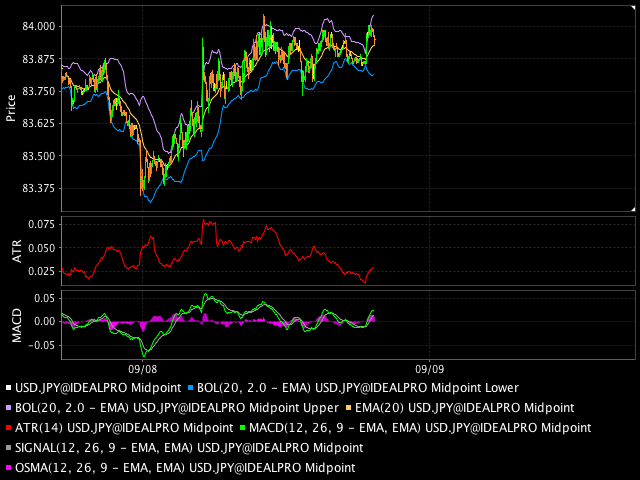
I do feel a bit like Alice. TheUSD/JPY pair rallied in London and New York trading after selling off in Asian trading. The FX rate established a new 15-year low during the session, trading down to levels of 83.35. I took profits on the pop, during morning U.S. trading, around 84.00 levels. Prices recovered when Finance Minister Yoshihiko Noda 'said he is prepared to take “bold” steps on currencies if necessary.' However, I am contemplating a long position in the Yen until 82.50. I watched the tape for the majority of the past 48 hours (fun times) to get a feel for directionality. I am confident prices will move lower.

Part of me wants to believe all of this intervention talk, led by PM candidate Ichiro Ozawa, will lead to more 'normalized' price levels (i.e. 88-90). However, my sinister half believes this was a short-covering rally today. In the ten minutes preceding the Beige Book announcement the pair came to an abrupt slow down in trading. Once the words 'decelerated growth' were uttered on CNBC prices gapped down to 83.79-81. During President Obama's 'Economic Speech', shortly thereafter, prices jumped back up to 83.92-95 levels. Hence, U.S. economic speak was not a significant momentum catalyst, net of direction, for the pair.


JPY 2day chart- 5 minute bars


Will the tape top out at 84.125 resistance levels? What has changed over the past 48 hours to stunt the momentum of a six month downtrend in the USD/JPY pair? Clearly, many uncertainties and rapid-fire change engulf trading. Thus, I look to a glut of international economic data releases that may potentially impact price directionality:

19:50- JPY BSI Large Manufacturing Conditions
01:00- JPY Household Confidence
02:00- JPY Machine Tool Orders
02:00- German CPI (MoM)
04:30- ECB Monthly Report
07:00- BoE Interest Rate Decision
08:30- U.S. Trade Balance
08:30- U.S. Initial Jobless Claims
19:50- JPY GDP(QoQ)
19:50 BoJ Monetary Policy Meeting Minutes


If I have learned one thing in my short few years of trading it is, 'don't trade against the tape.' I will leave you with some wise words from Adam Smith:

"The chance of gain by every man is more or less overvalued, and the chance of loss is by most men undervalued and by scarce any man who is in tolerable health and spirits valued more than it is worth."

Patrick M. Ambrus
Twitter: AnalyzeCapital

---------------------------
USD/JPY = 93.9150 as of 19:37 EST. The 'Matrix' theme for this post was inspired by a fellow trader of mine, Sauros, please view his blog: http://blog.thelordoftrading.com/2010/09/welcome-back-to-real-world-neo.html. Yoshihiko Noda quote was borrowed from Bloomberg.com.

Tuesday, September 7, 2010

Japanese Machine Orders


Japanese machinery orders rose for a second month in July as overseas demand encouraged investment by companies. Orders, an indicator of business investment in three to six months, rose 8.8 percent from June, when they increased 1.6 percent, the Cabinet Office said today in Tokyo. The median forecast of 25 economists surveyed by Bloomberg News was for a 2 percent gain.

Bloomberg.com


I am short the JPY at these levels. I expect political instability to derail or at least correct the temporary risk aversion flows into the JPY. The Beige Book tomorrow ought to clarify the FED's stance on 'QE 2.'


Patrick M. Ambrus
Twitter: AnalyzeCapital

Thursday, September 2, 2010

FX Briefing

The USD/JPY pair is yet to break out of its trading range established during the last 2 sessions between 84.00-to about 84.50. I'm still waiting for an entry around 83.75. I expect Non-Farm Payrolls to drive the pair lower in early trading tomorrow morning.

On another note, the EUR/USD pair is up marginally sitting at 1.2815. I'm looking for a rally to the 1.2950 levels before I get long. The Dollar Index is flat on the session pairing early morning declines.


'The US Dollar Index includes the exchange rates of the following six currencies: euro (EUR), Japenese yen (JPY), Pound sterling (GBP), Canadian dollar (CAN), Swedish krona (SEK), and Swiss franc (CHF).'

Investor Glossary.com


The table comes courtesy of Interactive Brokers


Patrick M. Ambrus
Analyze Capital LLC
Twitter: AnalyzeCapital

Monday, August 30, 2010

The Three Musketeers: USD/JPY, VIX, & SPX

USD/JPY 6 month Daily Chart


-I expect to see a retest of 83.75 levels, possibly as low as 83.25
-The BOJ cannot solely rely on tough talk to weaken the Yen, they must show & prove intervention to the market
-Momentum and Volatility remain flat; no reason to get long or short until a catalyst appears
-The 20 day SMA will serve as short-term resistance; 85.75-86.25
-RSI resistance at 55 levels remains firm
-Don't discount strong economic data; Unemployment sits at 5.3% and a Current Account Surplus is 3.3% of GDP.

Trade: I will get long once I see a retest of 83.75 lows. The BOJ will intervene through Quantitative Easing policies in order to allow the exchange rate to bounce to the upside. Once long, I'm looking for 800-1000 pips to the upside.

------------

VIX 6 month Daily


-200 Day SMA has held as a floor since the 'Flash Crash'
-The 20 day SMA is about to cross the 50 day
-RSI is poised to break through 60 and test 70 overbought levels last seen in May
-Momentum has plenty of room up to 2.5
-As long as money continues to flow out of Equities into Bonds, volatility will persist

-----------

SPX 6 month Daily


-A head and shoulders reversal pattern is well underway
-RSI failed at 50 and will go low until it tests oversold territory at 30
-Momentum topped out and has plenty of room to the downside
-The 20 day SMA will converge with the 50 day SMA in the next couple of trading sessions
-The above chart supplements the VIX story
-This week Consumer Sentiment, China PMI, Euro Zone PMI, U.S. ISM, and NFP take the market sentiment spotlight

Trade: Short SPX till 1000. Look for short-covering/a relief rally before entry. ES Mini Futures are a great place to start. Also, the ProShares UltraShort S&P500 ETF SDS is another way to double down on your bets.

-----------

Related ETFs: ProShares UltraShort S&P500 (SDS), CurrencyShares Japanese Yen Trust (FXY), iShares MSCI Japan Index (EWJ), Consumer Discret Select Sector SPDR (XLY)


Patrick M. Ambrus
Analyze Capital LLC
Twitter: AnalyzeCapital

Wednesday, June 16, 2010

Daily Market Recap-06.16.2010


Equity Indexes
INDU- 10,409.46 4.69 (+0.05%)
NASDAQ- 2,305.93 0.05 (+0.00%)
SPX- 1,114.61 -0.62 (-0.06%)

Commodities
WTI Crude Oil- $77.560 0.620 +0.81%)
Brent Crude Oil- $78.120 1.020 (+1.32%)
Natural Gas- $5.017 -0.172 (-3.31%)
Gold Spot- $1231.400 -3.000 (-0.24%)
Silver Spot- $18.465 -0.113 (-0.61%)

Bonds
2 Year UST- Price:100.05 (+0.05) Yield: 0.73% (-0.02)
10 Year UST- Price:102.00 (+0.34) Yield: 3.26% (-0.04)
10 Year Gilt- Price:109.91 (+0.15) Yield: 3.53% (-0.02)
2 Year Schatz- Price:100.01 (+0.25) Yield:0.50% (-0.012)
10 Year Bund- Price:102.85 (+0.28) Yield: 2.67% (-0.003)
10 Year Oats- Price:103.21 (-0.05) Yield: 3.11% (+0.01)
10 Year JGB- Price:100.49 (-0.09) Yield: 1.24% (+0.01)

Foreign Exchange
EUR/USD = 1.2309
GBP/USD = 1.4733
USD/JPY = 91.4500
USD/CAD= 1.0244
EUR/JPY = 112.5685

Equity Index Futures
Nikkei 225- 10,040.00 -50.00 (-0.50%)
Topix- 893.50 -1.00 (-0.11%)
Hang Sang- 20,145.00 56.00 (+0.28%)
SPI 200- 4,558.00 4.00 (+0.09%)

Today I did not trade. We had some administrative issues to take care of with our platform. Tomorrow I will be back at it. I enjoyed Obama last night. Short and to the point.

The Lake Shows dominated the Celtics last night. One more victory and Kobe will have 5 rings, Phil 11. Spain lost in their opening match-up. They better pick u the pace seeing as I have them winning it all.

Related ETFs: FXB:US Currency Shares British Pound Sterling Trust, DUG:US ProShares UltraShort Oil & Gas

Patrick M. Ambrus
Managing Partner
Analyze Capital LLC
Twitter: AnalyzeCapital

Monday, June 14, 2010

Market Recap- 06.14.2010


Equity Indexes
INDU- 10,190.89 -20.18 (-0.20%)
NASDAQ- 2,243.96 0.36 (+0.02%)
SPX- 1,089.63 -1.97 (-0.18%)

Commodities
WTI Crude Oil- $75.060 1.280 (+1.73%)
Brent Crude Oil- $74.970 0.620 (+0.83%)
Natural Gas- $5.030 0.249 (+5.21%)
Gold Spot- $1222.800 -7.400 (-0.60%)
Silver Spot- $18.235 0.004 (+0.02%)

Bonds
2 Year UST- Price:100.03 (-0.02) Yield: 0.73% (+0.01)
10 Year UST- Price:102.02 (-0.22) Yield: 3.26% (+0.03)
10 Year Gilt- Price:109.83 (-0.72) Yield: 3.54% (+0.08)
2 Year Schatz- Price:100.01 (-0.06) Yield:0.49% (+0.30)
10 Year Bund- Price:103.14 (-0.64) Yield: 2.63% (+0.07)
10 Year Oats- Price:103.40 (-0.59) Yield: 3.09% (+0.07)
10 Year JGB- Price:100.54 (-0.11) Yield: 1.24% (+0.00)

Foreign Exchange
EUR/USD = 1.2228
GBP/USD = 1.4751
USD/JPY = 91.5300
USD/CAD= 1.0325
EUR/JPY = 111.9850

Equity Index Futures
Nikkei 225- 9,890.00 10.00 (+0.10%)
Topix- 878.00 2.00 (+0.23%)
Hang Sang- 20,089.00 241.00 (+1.21%)
SPI 200- 4,528.00 2.00 (+0.04%)


Big moves in commodities markets today. Natural Gas was up over 5% on concerns of a worse then expected hurricane season. Crude oil also rallied. U.S. Equities were marginally positive throughout the day with the SPX briefly trading @ 1103. The Dollar paired back some gains from last week's strength. Today, I monitored my positions but did not actively trade.

The Lakers lost last night. Celtics now lead the series 3-2. I still expect LA to win the its 2nd consecutive championship. In world cup news Netherlands beat Denmark 2-0 on some goal keeping errors. Tomorrow Portugal takes on Ivory coast at the start of U.S. equity trading.

Realted ETF's: SPY:US SPDR S&P 500 ETF Trust, DIG:US ProShares Ultra Oil & Gas

Patrick M. Ambrus
Managing Partner
Analyze Capital LLC
Twitter: AnalyzeCapital

Friday, June 11, 2010

Market Recap- 06.11.2010


Equity Indexes
INDU- 10,211.07 38.54 (+0.38%)
NASDAQ- 2,243.60 24.89 (+1.12%)
SPX- 1,091.60 4.76 (+0.44%)

Commodities
WTI Crude Oil- $73.780 -1.700 (-2.25%)
Brent Crude Oil- $74.350 -0.940 (-1.25%)
Natural Gas- $4.781 0.134 (+2.88%)
Gold Spot- $1230.200 8.000 (+0.65%)
Silver Spot- $18.231 -0.120 (-0.65%)

Bonds
2 Year UST- Price:100.05 (+0.11) Yield: 0.73% (-0.06)
10 Year UST- Price:102.23 (+0.72) Yield: 3.23% (-0.08)
10 Year Gilt- Price:110.55 (+0.84) Yield: 3.46% (-0.10)
2 Year Schatz- Price:100.07 (+0.096) Yield:0.25% (-0.048)
10 Year Bund- Price:103.79 (+0.39) Yield: 2.56% (-0.04)
10 Year Oats- Price:103.99 (+0.39) Yield: 3.02% (-0.04)
10 Year JGB- Price:100.65 (-0.23) Yield: 1.24% (+0.03)

Foreign Exchange
EUR/USD = 1.2113
GBP/USD = 1.4549
USD/JPY = 91.6550
USD/CAD= 1.0360
EUR/JPY = 110.6800

Today I exited my SPX position before the close of trading. Locked in my Profits. My Short USO position recovered today and I will maintain my stance until I see evidence contrary to my view. In addition, I cashed out my short Nat Gas position for some small profits. I also went short the CAD and long USD around 16:00.

The Lake Show lost last night and foiled my "LA in 5" prediction. However, in order to win the Championship they need to win game 5 to preserve home court. Bynum was missed last night. Tomorrow I'll be watching some Futbol.

Related ETFs: FXC:US CurrencyShares Canadian Dollar Trust, USL:US United States 12 Month Oil Fund LP, SSO:US ProShares Ultra S&P500

Patrick M. Ambrus
Managing Partner
Analyze Capital LLC
Twitter: AnalyzeCapital

Wednesday, June 9, 2010

First Thoughts on Merkel's Address


Via WSJ:

The measure spent much of the session above that level but quickly fell through it as Ms. Merkel defended Germany's €80 billion austerity package for the next four years, saying Wednesday that the time to withdraw stimulus has come and lessons from the debt crisis must be learned.

Investors said Ms. Merkel's comments that the bailout package only buys time for the euro zone spooked the market. Coming from Germany, considered the strongest economy in Europe, the remarks underscore the euro zone's problems.


If this signals the start of austerity for Europe, so much the better, as long as the necessary measures are still taken by politicians should something unexpected happen to the economy. What does this affect the big picture?

• Under macroeconomic theory, a combination of tight fiscal policy and loose monetary policy is likely to depreciate the currency of a country.
• This adds some fun to the game of euro, as we see FX responding immediately; however,
• A depreciating currency is beneficial to economic recovery, and corresponds to recent export-oriented recovery schemes.

If you ask me, I'd say the woman from Germany has got some guts. Politics is one of the rare field where saying something actually has the equal, if not more, weight as doing something. Her defense for the austerity plan changes the tone of the game, and might have the extensive influence of pushing other European countries to follow suit. After all Germany has the healthiest balance sheet of the continent. As Europe adjusts its debt level by adopting a tight fiscal policy, and given that the rest of the world is likely to grow at a higher pace economically, we should be more confident that the euro will becomes weaker in the future.

Yi Gao
SUmmer Analyst
Analyze Capital LLC

U.S. Policy-Makers vs. The RMB


Via Bloomberg:

The U.S. Senate will vote within two weeks on a measure aimed at getting China to raise the value of its currency, Senator Charles Schumer of New York said today.

Lawmakers are prodding President Barack Obama to take a tougher line on China, which has held the value of the yuan at about 6.83 to the dollar since July 2008. Senator Sherrod Brown, an Ohio Democrat, has said a weak yuan gives Chinese exporters an unfair advantage over their U.S. competitors.


This vote will lead to a significant change. If China has to raise the currency exchange rate, the economy will hurt a lot. It may as someone would say, "lead to a disaster". The Chinese government has refused to allow the Yuan to appreciate many times. The negative results for China to raise the value of RMB are strong and direct:

- Reduction of exporting; exporting supports GDP growth and employment, and thus destabilizing society
- The economic model of China is typically of the investing pull economy. If the RMB appreciates, the cost of production will increase and FDI will decrease immediately
- China is still the biggest "factory" for the world and US consumers. The appreciation of the Yuan will directly affect product pricing
- The sudden appreciation will destroy the balance of demand and supply in China and lead to inflation

Liz T. Liu
Summer Analyst
Analyze Capital LLC

Monday, June 7, 2010

Market Recap- 06.07.2010


Equity Indexes
INDU- 9,816.49 -115.48 (-1.16%)
NASDAQ- 2,173.90 -45.27 (-2.04%)
SPX- 1,050.47 -14.41 (-1.35%)

Commodities
WTI Crude Oil- $71.180 -0.330 (-0.46%)
Brent Crude Oil- $71.710 -0.380 (-0.53%)
Natural Gas- $4.944 + 0.147 (3.06%)
Comex Gold- $1241.80 +24.10 (1.98%)
Comex Sliver- $18.15 +0.85 (4.92%)

Bonds
10 Year UST- Price:100.08 (+0.52) Yield: 3.14% (-0.06)
10 Year Gilt- Price:110.30 (+0.17) Yield: 3.49% (-0.02)
10 Year Bund- Price:103.82 (+0.19) Yield: 2.56% (-0.02)
10 Year JGB- Price:100.61 (+0.30) Yield: 1.23% (-0.04)

Foreign Exchange
EUR/USD = 1.1914
GBP/USD = 1.4465
USD/JPY = 91.345
USD/CAD= 1.0615
EUR/JPY = 108.8312

Equity Index Futures
Nikkei 225- 9,580.00 +70.00
Hang Sang- 19,335.00 -479.00
SPI 200 - 4,301.00 -37.00

Thoughts
I traded some Gold via GLD this morning and was able to lock in a 2% gain by days end. There was no meaningful economic catalyst to drive equity prices higher today. Bearishness looms everywhere. This may be a great time to jump back in equities if one is still Bullish. I am. Tomorrow I will look for an entry position to get long the SPX.

Related ETF's: GLD:US SPDR Gold Trust, SPY:US SPDR S&P 500 ETF Trust, SSO:US ProShares Ultra S&P500, DIA:US SPDR Dow Jones Industrial Average ETF Trust


Patrick M. Ambrus
Analyze Capital LLC
Twitter: AnalyzeCapital

Friday, June 4, 2010

A weaker euro (or Europe?)


A solid article on the cheaper euro’s economic impact was released by The Economist last week. Titled “A Mixed Blessing”, the article explores the many advantages and disadvantages that a weak euro might have during an economic recovery. It states that “the cheaper euro will be good for some European companies – up to a point.” Today’s blog, I’d like to summarize some of the interesting insights that were offered.

· The euro’s decline….should bolster exports for big manufacturers (particularly in northern Europe) and luxury-goods companies (particularly in Italy and France) while boosting tourism across the continent.

· However, “because most businesses loathe uncertainty….some [didn’t expected the euro to decline, and instead have] locked themselves into hedging arrangements that will prevent them from taking advantage of the lower euro until next year or even the year after”

· On the other hand, as euro becomes weaker, “European companies will find it more expensive to raise capital internationally. They will also have to pay more for commodities such as oil which are priced in dollars,” and

· Since “even Germany does more trade with France than any other country….this means that the huge number of European companies that export mainly within the euro zone are seeing the costs of their raw materials rise without any accompanying benefits. “

The most important insight the article offers, however, points to the fact that structural problems have been created by the single currency. It is not “weak euro versus strong euro”, but whether there should be a single currency for the entire continent at all.

As politics, the euro might have contributions in making alliances among European countries more approachable (open to debates); as a policy, it has not been able to “spark a glorious period of innovation and productivity growth.” Forcefully bonding together a group of vastly different economies may not have been a good idea after all. We might want to wonder if the currency has left the continent less competent intrinsically, and whether Europe actually needs it or not.

Via The Economist:

http://www.economist.com/businessfinance/displaystory.cfm?story_id=16216111


Yi Gao
Research Analyst
Analyze Capital LLC
e-mail:anlyzecapital@gmail.com

EUR/USD Decline-06.04.2010


Via Bloomberg:

The euro may re-test a four-year low versus the dollar after failing to rebound on a so-called double bottom trading pattern, according to FXPrime Corp.

“The failure to rebound after forming a double bottom blew off positive technical signals for the currency,” he said. “The euro is likely to resume a downtrend and re-test a 50 percent Fibonacci retracement line from a historical high.”


The euro made two troughs of about the same depth on May 19 and May 27 in a so-called double-bottom pattern, before breaking through those levels on June 1 to drop to $1.2111, the lowest level since April 2006. The currency’s 50 percent retracement is at $1.2134, based on the low of 82.30 U.S. cents in October 2000 and its record high of $1.6038 in July 2008.

My view: As long a bad news keeps coming out of Europe, the euro will keep declining. Investors should not rely heavily on support levels for the euro.

Daniel A.
Summer Analyst
Analyze Capital LLC
email:analyzecapital@gmail.com

Wednesday, June 2, 2010

The Economist: Fear returns


On the cover of its latest issue, The Economist featured a shark sneaking underwater. Barely a month ago, its front page read "Hope, finally". How sentiments change so quickly in the wake of a recession is nothing less than remarkable. So what do we do to “avoid a double-dip recession"? Here I am going to borrow some ideas from the term paper I wrote for my macro analysis course last spring.

One thing for sure is that we have reasons to remain cautious and even pessimistic, though it's probably safe to say that the worst is behind us. To me the difficulty today is not a double-dip recession, but a sluggish recovery for years to come. It's unlikely that we would see another systemic default of the economy, given the decisive actions governments have carried out during the crisis. However when we examine one by one the four cartage (consumption, government purchases, investment, net exports) dragging the economy forward, it becomes really hard to believe that future is free of worries:


- Consumption, several factors make spending our way back to prosperity rather unrealistic:
  1. unemployment.
  2. less household wealth, diminished values of portfolios and houses
  3. fear caused by the first two factors may as well transform the spending habits of the consumer. The average Joe is turning into, if never too much of a saver, less of a spendthrift.
- Government purchases:
  1. A soaring deficit is highly undesirable during an economic recovery, for it could make financing costlier for both the public and private sectors, and politically weaken the administration’s control to do what is needed. And since technically we are not in recession any more, a Keynesian approach may fall out of the vote seeking politician's favor.
- Investment:
  1. An optimistic stock market does not automatically signal the healing of the system, whereas a financial system that remains abnormal affects virtually every participant in the economy. For private companies, the premium they have to pay to attract capital is still very high as compared to earlier recoveries, signaling a lack of confidence in the bond markets. Since small businesses, employing 500 people or fewer, have traditionally accounted for 65 percent of all new jobs created. If these companies could not get money for their projects, they will not be in a position to hire people or make capital investment
- Exports:
  1. Many economists agree that exporting our way back to prosperity is the optimal way to go. There is real hope here, but not certainty.
  2. The U.S. is the dominant exporter of "knowledge oriented" goods, things that cannot be produced easily by a sweat-shop in China.
  3. A combination of tight fiscal and loose monetary policy is likely to lower the exchange rate, and make U.S. goods more competitive abroad.
  4. However, exchange rates cannot be firmly controlled, and the dollar tends to not behave in the way it is told.
  5. Crisis abroad might cause capitals to flow into the dollar and make it appreciate.

All told, the road to recovery is a game of confidence. Until one of the horses dragging the cart wakes up and “ignites” the rest, things will remain sleepy as they are. This is not to say that over-confidence is golden; the economy is still in a feeble stage, and it will take exceptional vigilance and execution to lead it to where it needs to be. Perhaps we don't have to be pessimistic, but caution is indeed needed going forward.


Yi Gao
Research Analyst
Analyze Capital LLC

 
Disclaimer
This Blog has been developed by Analyze Capital LLC, and as an independent organization we provide “AS IS” information without warranty. The ideas and opinions expressed by the contributers of this blog are personal and do not represent the actions or policies of Analyze Capital LLC. The contents of this blog do not intend to assert recommendations or to offer advice of any kind. We are not responsible the consequences, be they gains or losses, that may result from using any of the information from this blog.